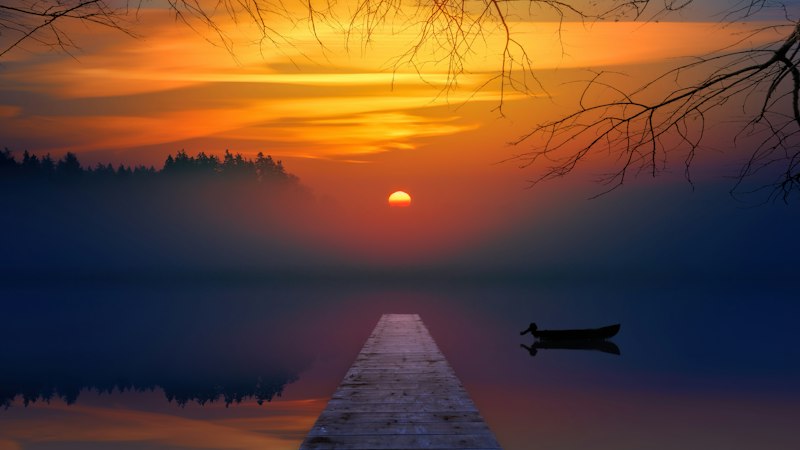
You wake before dawn—still tangled in the dream’s golden threads. The horizon bleeds crimson, then amber, then a blinding white so pure it hurts your eyes. You’re standing on a cliff, barefoot, the wind tugging at your sleeves. Below, the ocean stretches endlessly, its surface catching the first light like scattered diamonds. You don’t remember climbing here, but your body knows this place. Your chest swells with something wordless—hope? grief?—as the sun breaches the edge of the world. It’s too much. You want to look away, but you can’t. You’re frozen, suspended between night and day, between what was and what’s coming.
Then, just as suddenly, the dream flips. The sun isn’t rising—it’s falling. A slow, molten descent into the sea, dragging the sky with it in streaks of violet and burnt orange. You’re on a rooftop now, the city sprawled beneath you, its edges softening in the dusk. Your hands grip the railing, knuckles white. There’s a clock tower in the distance, its hands spinning backward. You know, with dream-logic certainty, that when the sun disappears, something will end. Or begin. Your breath comes shallow, your ribs a cage around a heart that’s beating too fast, too slow—you can’t tell which.
The Symbolic Meaning
The sunrise and sunset in your dreams aren’t just light—they’re thresholds. Jung saw the sun as the ultimate symbol of consciousness, its daily arc a mirror of the psyche’s journey. A sunrise? That’s the inflation of the ego, the moment your unconscious material rises into awareness. It’s not just a new day—it’s a new you, emerging from the dark. But a sunset? That’s the shadow swallowing the light. It’s not an ending—it’s an invitation to descend, to integrate what you’ve spent the day avoiding.
These dreams often arrive when you’re on the cusp of change. A promotion, a breakup, a diagnosis—something that demands you step into the unknown. The sunrise doesn’t ask if you’re ready. It just is. And the sunset? It doesn’t wait for permission to fade. Both are ruthless in their timing. That’s why they unnerve you. They’re not gentle metaphors. They’re archetypal forces, pulling you toward transformation whether you like it or not.
The Emotional Connection
You dream of sunrises when you’re holding your breath—waiting for a test result, a job offer, a sign that the thing you’ve been building toward is finally here. The light feels like relief, but your body knows better. Your stomach clenches. Your jaw locks. The sunrise isn’t just hope—it’s pressure. What if the light reveals what you’re not ready to see?
Sunsets, on the other hand, visit when you’re drowning in ambiguity. A relationship teetering on the edge. A career that no longer fits. A grief that won’t name itself. The dying light isn’t sad—it’s honest. It strips away the distractions, leaving only the raw truth: something must shift. And your nervous system rebels. Your shoulders hunch. Your breath turns shallow. The sunset isn’t an ending—it’s a reckoning.
“I kept dreaming of this endless sunset—orange bleeding into black, over and over. I was in the middle of leaving my job, and the dream wouldn’t stop. Then I realized: the sunset wasn’t about the job ending. It was about me ending—my identity, my routine, the version of myself I’d been clinging to. The dream wasn’t predicting doom. It was showing me the shape of my fear.”
— Testimonial from Onera user, mapped to somatic release exercises for transition anxiety
Where This Dream Lives in Your Body
Your body doesn’t just see the sunrise or sunset—it feels it. Here’s where the dream’s charge gets trapped:
- Sternum (center of the chest): That ache behind your breastbone? It’s the weight of becoming. The sunrise stretches you open, like a flower forced to bloom too soon. The sunset compresses you, like a fist closing around your heart. Either way, your sternum holds the tension—am I allowed to take up space? Am I allowed to let go?
- Diaphragm (just below the ribs): Your breath stutters in these dreams. The diaphragm locks, turning each inhale into a struggle. That’s your body resisting the inevitability of the sun’s movement. You can’t stop the dawn. You can’t halt the dusk. But your diaphragm tries anyway, tightening like a drum.
- Pelvis (hips and lower back): The sunrise dream leaves your hips restless, like you’re being pulled forward. The sunset dream roots you in place, your lower back heavy, your pelvis a bowl spilling over with unprocessed grief. Both are about grounding—or the lack of it. Where do you stand when the world is shifting?
- Throat (collarbone to jaw): The light changes, but your voice stays stuck. Your throat constricts, your jaw clenches. The sunrise wants you to declare yourself. The sunset wants you to release. Neither lets you stay silent.
- Eyes (temples and brow): The brightness burns. Your temples throb. Your brow furrows, trying to shield you from the glare. But the dream won’t let you look away. The sunrise demands you see what’s coming. The sunset demands you witness what’s leaving.
Somatic Release Exercise
“Threshold Breathing”
For: Sunrise/sunset dreams where you feel frozen, suspended between states (e.g., “I was watching the sun rise, but I couldn’t move”).
Why it works: These dreams activate the dorsal vagal complex—the part of your nervous system that shuts you down when change feels overwhelming. Threshold Breathing resets your vagal tone by pairing movement with breath, signaling safety to your body. (Levine’s Somatic Experiencing framework calls this “pendulation”—oscillating between activation and calm to restore equilibrium.)
How to do it:
- Find the edge: Stand in a doorway. Place one hand on the left frame, one on the right. Your body is the threshold.
- Inhale (4 sec): Lean forward slightly, as if stepping into the light (or the dark). Feel the stretch in your chest and hips.
- Hold (2 sec): Pause. Notice where your body resists—clenched jaw? Tight diaphragm? Don’t fix it. Just witness.
- Exhale (6 sec): Lean back, releasing your hands from the frame. Let your shoulders drop. Imagine the sun’s light (or shadow) moving through you, not over you.
- Repeat (5x): Alternate between leaning into the “sunrise” (forward) and “sunset” (back). With each cycle, let your breath deepen, your stance widen. Your body learns: change is not a fall. It’s a rhythm.
Pro tip: If your diaphragm locks, hum on the exhale. The vibration soothes the vagus nerve, easing the “stuck” feeling.
Dream Variations and Their Specific Meanings
| Dream Scenario | Psychological Meaning | Body Cue to Watch For |
|---|---|---|
| Watching a sunrise from a mountaintop | You’re on the verge of a breakthrough—but the altitude scares you. The mountaintop is your ego’s fear of exposure. What are you afraid people will see if you “rise”? | Tingling in your fingertips (nervous system overloaded with anticipation) |
| Running toward a sunset that keeps moving away | You’re chasing a fantasy of closure. The sunset isn’t running—you’re refusing to let it go. What would happen if you stopped? | Burning in your thighs (body begging you to stop the futile effort) |
| A sunrise that turns into a sunset mid-dream | You’re caught in cognitive dissonance. The dream mirrors a situation where you’re holding two conflicting truths (e.g., “I love them” vs. “I need to leave”). Your psyche is forcing a reckoning. | Nausea (your body’s way of saying, “This can’t coexist”) |
| Painting a sunrise/sunset and the colors won’t blend | You’re trying to force integration. The dream is showing you where your shadow resists harmony. What part of yourself are you trying to “smooth over”? | Tension in your dominant hand (creative frustration, fear of imperfection) |
| A sunset that never ends (the sky stays orange for hours) | You’re stuck in liminal time. The dream reflects a transition that’s dragging—grief, a career shift, a relationship limbo. Your psyche is asking: What are you avoiding by not letting night fall? | Heavy eyelids (your body wants to “sleep” on the problem) |
| Watching a sunrise/sunset with a stranger who feels familiar | The stranger is an aspect of your anima/animus—the inner feminine/masculine you’ve neglected. The dream is a nudge to reclaim that energy (e.g., if the stranger is calm during a sunset, maybe you need to embrace your own capacity for surrender). | Goosebumps (your body recognizing “home” in the stranger) |
| A sunrise that burns your skin | You’re resisting your own power. The burn isn’t punishment—it’s friction. What part of your potential are you afraid to step into? | Flushed cheeks (shame or excitement—your body can’t tell the difference) |
| A sunset that reveals a hidden path | The dream is a shadow initiation. The path appears only when the light dims because it’s leading you to what you’ve been too afraid to see. Trust the dark. | Cold feet (your body’s hesitation to step forward) |
| Multiple suns rising or setting at once | You’re juggling too many identities. The dream reflects a life where you’re spread thin—parent, partner, professional, etc. Your psyche is asking: Which sun is yours? | Dizziness (your vestibular system overwhelmed by “too many directions”) |
| A sunrise/sunset reflected in water | The dream is about duality. The reflection isn’t a copy—it’s the unconscious version of the light. What’s beneath the surface of your “new beginning” or “ending”? | Ripples in your belly (your gut sensing the hidden layers) |
📖 Go deeper: The Complete Guide to Dream Interpretation
Related Dreams
When the Light Doesn’t Lie
Sunrise and sunset dreams don’t just reflect your transitions—they map them onto your body. Onera traces the heat of the dawn to your clenched jaw, the weight of the dusk to your locked diaphragm, then guides you through somatic release exercises to meet the light (or dark) without flinching.
Discover What Your Dreams Mean →FAQ
What does it mean to dream about a sunrise or sunset?
A sunrise dream signals a psychological dawn—a new awareness, opportunity, or phase of life emerging from your unconscious. It’s not always positive; the light can feel exposing, even painful. A sunset dream, by contrast, marks a psychological dusk. It’s not about loss—it’s about integration. The dream is asking you to metabolize what’s ending so you can move forward. Both are thresholds, not destinations.
Is dreaming about a sunrise or sunset good or bad?
Neither. These dreams are neutral forces—like gravity. A sunrise isn’t “good” if you’re terrified of what the light will reveal. A sunset isn’t “bad” if you’re relieved to let something go. The charge comes from your body’s response. Do you feel expansion (sunrise) or contraction (sunset)? That’s your nervous system’s way of telling you whether the threshold ahead feels like safety or threat.
Why do I keep dreaming of the same sunrise or sunset?
Your psyche is stuck in liminal time. The recurring dream is a sign you’re avoiding the initiation the threshold demands. Maybe you’re clinging to an old identity (sunset) or resisting a new one (sunrise). The dream won’t stop until you move through it. Try this: Next time you wake from the dream, place a hand on your sternum and ask, “What am I not letting myself see?” Your body will answer before your mind does.
What does it mean to dream of a sunrise and sunset in the same dream?
This is a mandala dream—a symbol of wholeness. Jung saw the mandala as a representation of the self, and the sun’s full arc (rise and set) is the ultimate mandala. The dream is showing you that opposites can coexist. You’re not just the light or the dark. You’re the entire sky. The tension between the two isn’t a problem to solve—it’s the source of your power.
Disclaimer: Dream interpretations are not a substitute for professional mental health care. If your dreams are causing distress or disrupting your daily life, consider speaking with a therapist trained in somatic or depth psychology. Onera’s insights are based on established psychological frameworks but should not be used for diagnosis or treatment.